Every great Indian dish is a small machine of flavour. In this column, Ayaz takes one apart at a time — the ingredients, the history, the engineering, the joy — and puts it back together with love.
Butter Chicken: The Accident That Conquered the World
Take it apart and it's just tomato, butter, cream and smoke. Put it together and it's the most famous Indian dish on Earth. So — khaane mein kya hai?
A
By Ayaz मुर्ग़ मक्खनी, dissected with love
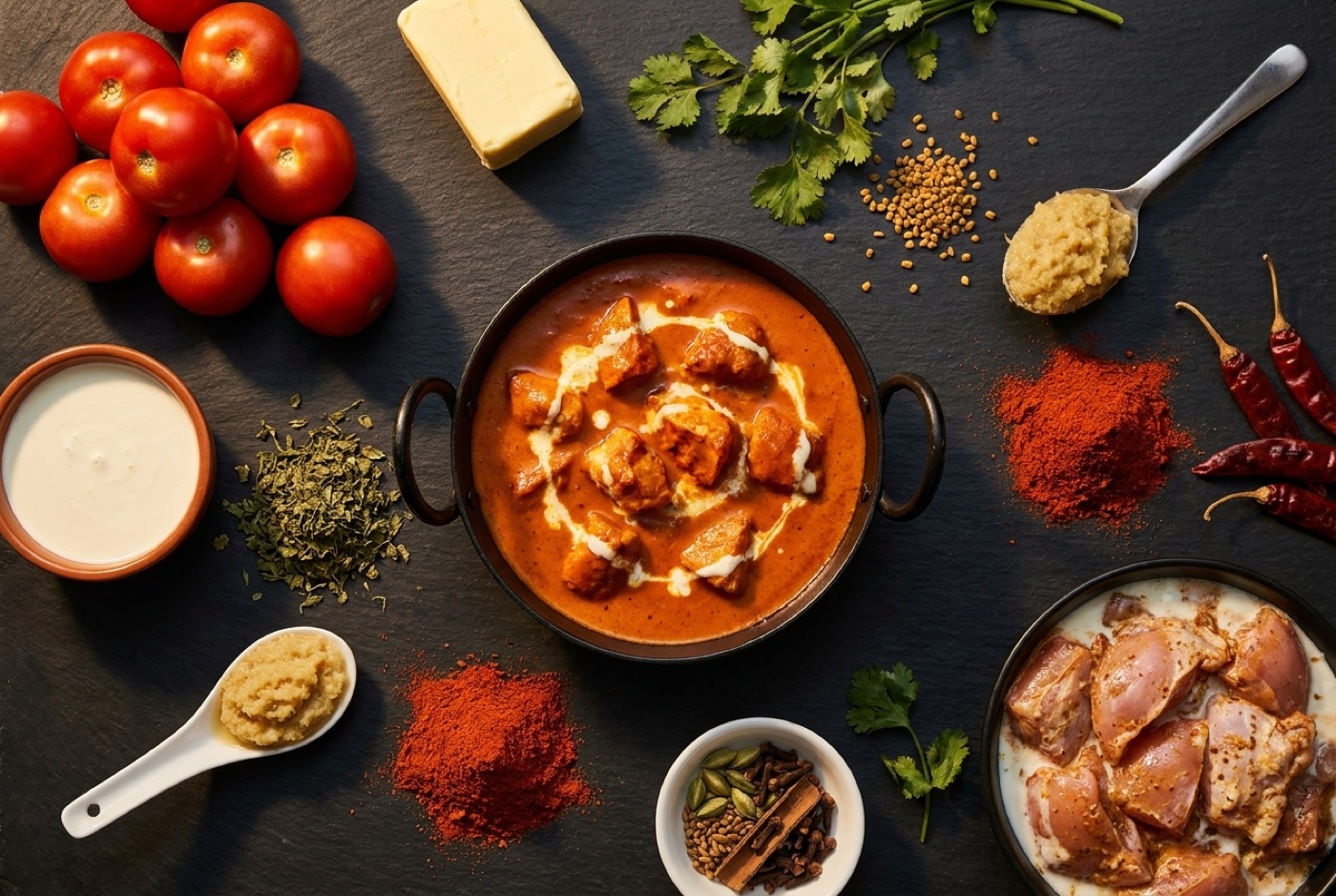
The whole machine, laid out: tomato, butter, cream, kasuri methi, smoke.
Khaane mein kya hai — the short answer
Tandoori chicken — yogurt-and-spice marinated, cooked over fierce heat for char and smoke.
The makhani gravy — slow-cooked tomatoes, butter, cream, a little sweetness.
The signature — kasuri methi (dried fenugreek), the haunting bittersweet note that makes it unmistakable.
Every legendary dish has an origin story, and butter chicken's is beautifully unglamorous: leftovers. The story goes back to old Delhi's Moti Mahal in the years after Partition, where cooks facing unsold tandoori chicken — which dries out as it sits — began reviving it in a gravy of tomatoes, butter and cream. The rescue mission turned out better than the original. Murgh makhani was born, and the world has never recovered.
Part one: the chicken
Real butter chicken starts a day early. The chicken is marinated twice — first in lemon and salt, then in a thick coat of hung curd, ginger-garlic paste, red chilli and garam masala — and then cooked hard and fast in a tandoor. This matters more than any other step: the char, the smoke, the slightly burnt edges are the backbone that keeps the dish from being merely creamy. A pale, poached chicken in orange gravy is not butter chicken; it is a missed opportunity wearing its clothes.
Part two: the gravy
The makhani base is patience disguised as luxury. Ripe tomatoes are cooked down slowly — with butter, a little ginger and garlic, Kashmiri chilli for colour more than fire — until they surrender their rawness and turn velvet. Then cream, then more butter, then the finishers: a spoon of honey or sugar to round the acidity, garam masala, and the hero — kasuri methi, dried fenugreek leaves crushed between your palms. That faint bittersweet haunting is the fingerprint of every great butter chicken. Miss it, and something is missing you can't name.
Butter chicken is not a curry. It is tandoori chicken that fell into velvet and decided to stay.
Why it works
Dissected, it's a masterclass in balance: smoke against cream, acid against sweet, bitter methi against rich butter. Nothing shouts. Everything hums. It's also why the dish travels so well — there's no unfamiliar edge to frighten a first-timer, just warmth stacked on warmth. Purists argue about how much cream is too much (answer: when you can no longer taste tomato), but the formula is forgiving, which is how it ended up on menus from Toronto to Tokyo.
Eat it like you mean it
With butter naan, obviously — the only bread engineered for this gravy — and raw onion rings and a wedge of lime to cut the richness. And if you're near Daman, you already know my spot: the dhaba-style version at Veera Da Dhaba, mopped up with a hot paratha under a village-themed roof.
Quick answers
What is butter chicken made of?
Tandoor-cooked marinated chicken in a gravy of slow-cooked tomatoes, butter and cream, finished with kasuri methi and garam masala. The marinade is yogurt, ginger-garlic and spices.
What's the difference between butter chicken and tikka masala?
They're cousins. Butter chicken (Delhi) is smoother, sweeter, butter-forward. Chicken tikka masala (popularised in Britain) is typically spicier and more onion-masala driven. Same skeleton, different accents.
#ButterChicken#MurghMakhani#KhaaneMeinKyaHai
Episode 26 min read
Pani Puri: Six Seconds of Perfect Chaos
It is the only dish in the world with a countdown timer. From the moment the puri is filled, you have six seconds. So — khaane mein kya hai?
A
By Ayaz गोलगप्पा · पुचका · पानी पूरी — one snack, many wars
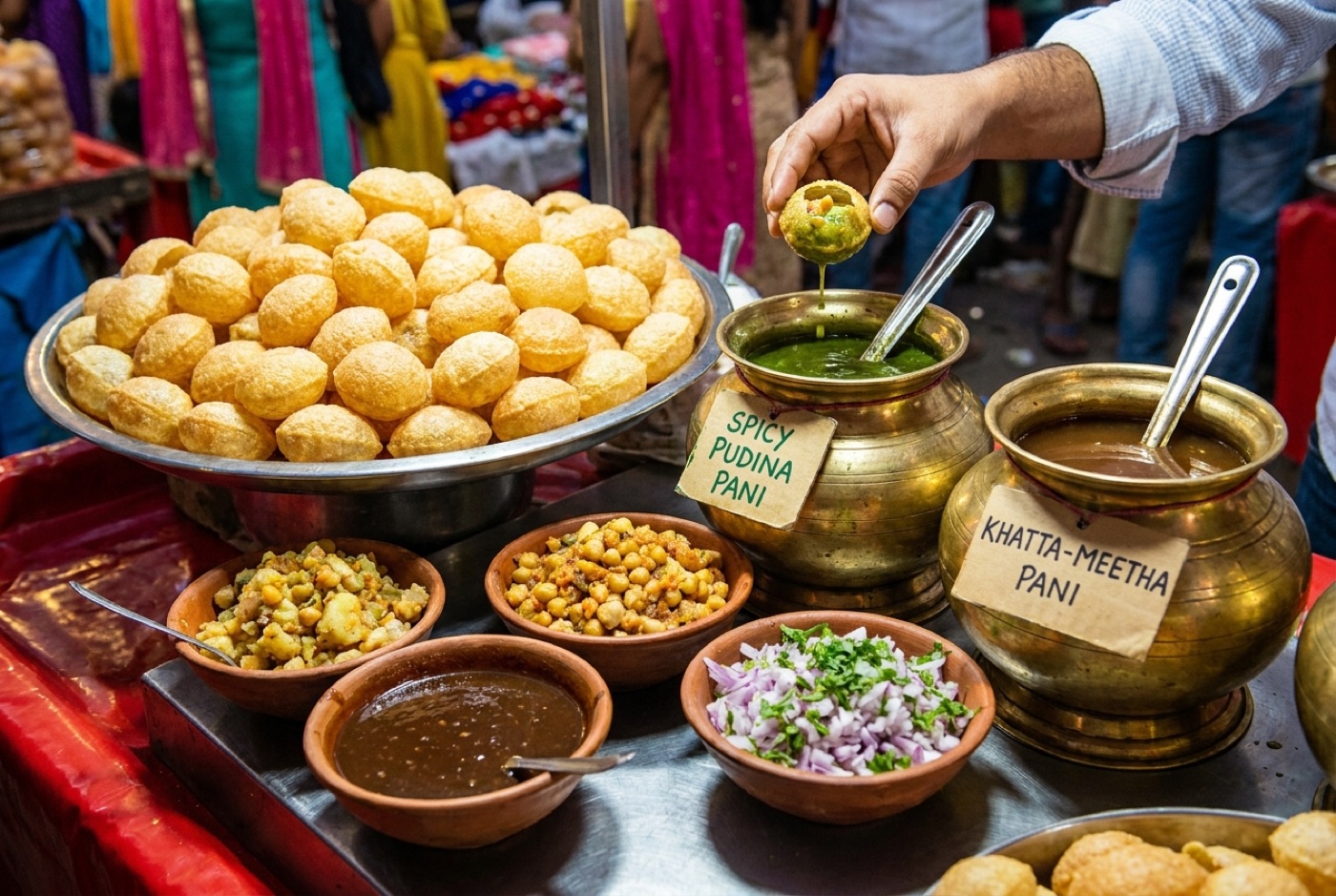
The arsenal: crisp puris, spiced filling, and the two waters that start the fireworks.
Khaane mein kya hai — the short answer
The puri — a fried semolina sphere, hollow, thin, and engineered to shatter.
The filling — spiced potato and chickpeas (or ragda, or sprouts, depending on your city).
The pani — chilled mint-coriander-chilli water sharpened with black salt and tamarind; plus its sweet twin.
Watch someone eat pani puri and you are watching a countdown. Fill, hand over, and the clock starts: the liquid is already soaking through, the structure is failing, and the only correct move is the whole thing, one bite, now. This is not a flaw. It is the entire design. Pani puri is engineered to self-destruct, and that six-second deadline is why no one ever eats it slowly, sadly, or alone.
The sphere
The puri is a small miracle of physics — a disc of semolina dough that, hitting hot oil, puffs into a hollow globe with walls thin enough to shatter and strong enough to hold liquid for exactly as long as needed. Too thick and it's bread; too thin and it's a puddle. Every vendor's puri is a calibration decades in the tuning.
The waters
The teekha pani is the soul: mint, coriander, green chilli and ginger blitzed and strained into ice-cold water, seasoned with kala namak — that sulphurous black salt that makes everything taste more alive — and soured with tamarind or lemon. Its partner is the sweet khatta-meetha pani of tamarind and dates. One slaps, one soothes. The correct ratio is a personal philosophy and grounds for lifelong friendship or feud.
Pani puri is the only food with a self-destruct timer — and that deadline is the whole point.
One snack, many nations
Cross India and the same idea changes name, size and personality: Mumbai's pani puri with ragda, Delhi's golgappa with sharper spice, Kolkata's puchka — darker, tangier, potato-forward — and gupchup across the east. Everyone believes their city's version is the original. Everyone is wrong and right. That argument, conducted while standing in a circle around the vendor, is part of the recipe.
The ritual
You do not order pani puri; you enter a relationship. The vendor sets the rhythm, plate by plate, reading your heat tolerance like a doctor. And when the round ends comes the free sukha puri — the dry one, crushed with a little filling — the full stop at the end of the sentence. Refusing it is legal, but only technically.
Quick answers
What is the pani in pani puri made of?
The spicy version blends mint, coriander, green chilli, ginger, black salt and roasted cumin in chilled water, soured with tamarind or lemon. The sweet version is tamarind-date water. Most vendors serve both.
Golgappa, puchka, pani puri — what's the difference?
Same family, regional accents: pani puri (west/south), golgappa (north), puchka (east — tangier, potato-heavy), gupchup (Odisha and around). Size, filling and pani sharpness vary by city pride.
#PaniPuri#Golgappa#StreetFood#KhaaneMeinKyaHai
Episode 36 min read
The Samosa: A Traveller Who Never Left
It crossed deserts with Persian traders, dined in Delhi's sultanate courts, and ended up at every Indian railway station. So — khaane mein kya hai?
A
By Ayaz The biography of a triangle
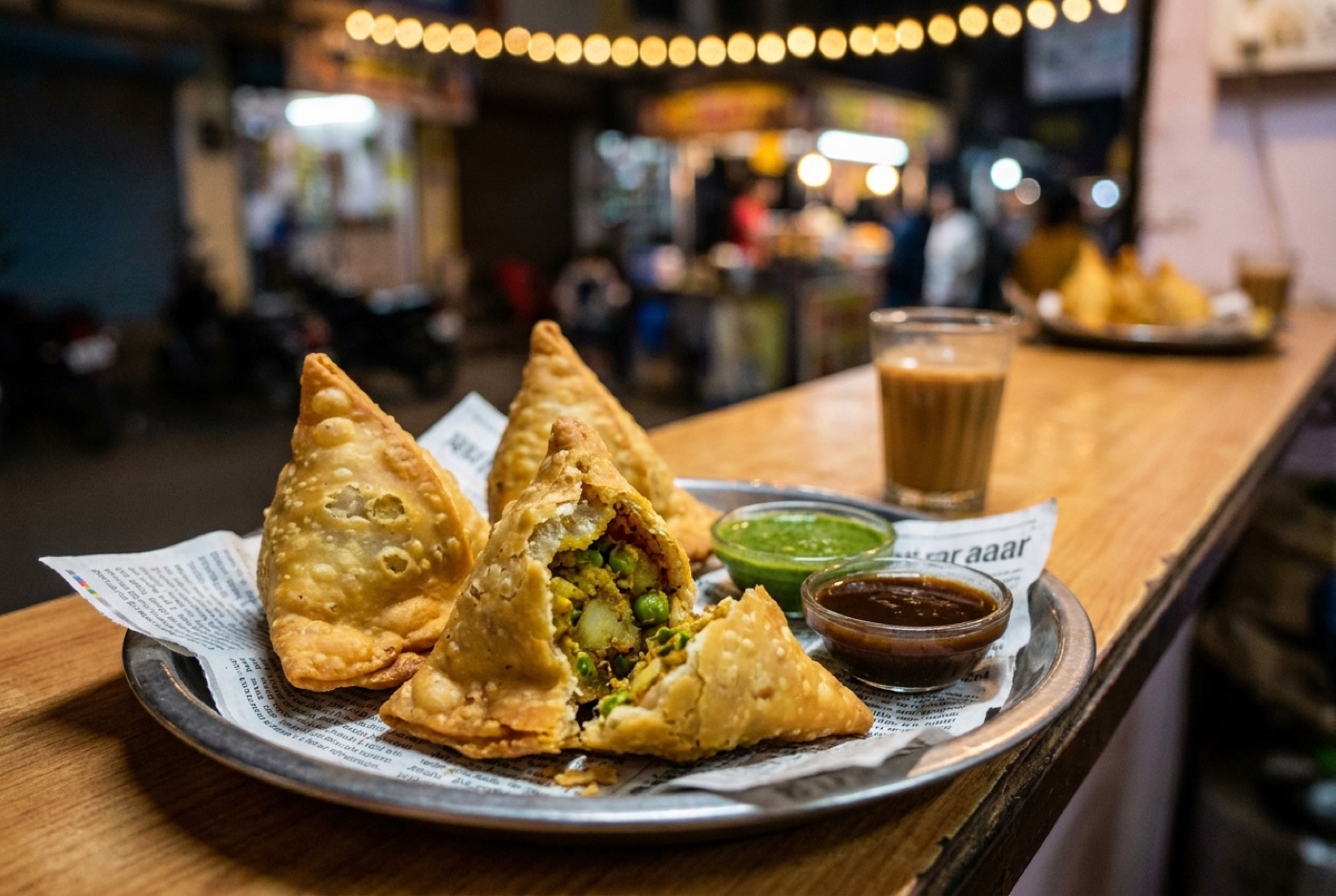
The reveal: crisp shell, spiced aloo heart, two chutneys standing by.
Khaane mein kya hai — the short answer
The shell — a stiff maida dough with ghee (the "moyan") that fries into flaky armour, not bubbles.
The heart — spiced potato and peas: cumin, coriander seed, green chilli, amchur for tang.
The escorts — green coriander-mint chutney and sweet tamarind, plus chai as the constitutionally mandated partner.
Before it was Indian, the samosa was a traveller. Its ancestor — call it sanbosag, sambusak, samsa — rode across Persia and Central Asia in saddlebags as a portable meat pie, and arrived in the subcontinent around the thirteenth century, where court chroniclers of the Delhi Sultanate wrote admiringly of princes snacking on it. India did what India does: adopted it, argued with it, and improved it beyond recognition.
The great potato coup
The modern samosa's defining moment came centuries later, when the Portuguese brought the potato to India. Somewhere along the way, the aloo staged a coup, evicted the mince, and installed itself — mashed, studded with peas, perfumed with cumin and coriander seed, brightened with amchur — as the rightful heart of the people's samosa. The meat samosa survives, gloriously, in Hyderabad and old Muslim quarters. But the aloo samosa became the republic.
Engineering the shell
The pastry is where amateurs fall. It is a stiff dough of maida with a generous rub of ghee — the moyan — which is what gives that flaky, blistered, khasta bite. And the frying is counterintuitive: low and slow, so the shell cooks through and crisps gradually. Hot, fast oil makes bubbles and a pale, sad shell. A proper samosa should sound like dry leaves when you break it.
The samosa entered India as a royal snack and stayed as a public servant.
A democracy of triangles
Today it costs less than a bus fare and shows up everywhere: railway platforms at dawn, office chai breaks at four, weddings, funerals, election rallies. Bengal folds it smaller and calls it singara, sometimes with cauliflower. Some cities stuff it with keema, some with noodles (we forgive them). And its destiny is the chai break — hot, sweet tea against hot, salty pastry — one of the great free pleasures of the subcontinent.
Quick answers
Where did the samosa originally come from?
Its ancestor came from Persia and Central Asia as a fried meat pastry (sanbosag/sambusak), reaching India around the 13th–14th century through traders and royal kitchens. The potato filling came much later, after the Portuguese introduced potatoes to India.
Why is my samosa shell not flaky?
Two usual culprits: not enough ghee rubbed into the dough (the moyan), or frying at high heat. Use a stiff dough and fry low and slow — the shell should crisp gradually, without bubbles.
#Samosa#FoodHistory#Chai#KhaaneMeinKyaHai
Episode 45 min read
Jalebi: Chaos Theory, Deep-Fried
No two jalebis are the same shape, and that's the secret of its charm. So — khaane mein kya hai?
A
By Ayaz इमरती की बहन, हलवाई की सुबह
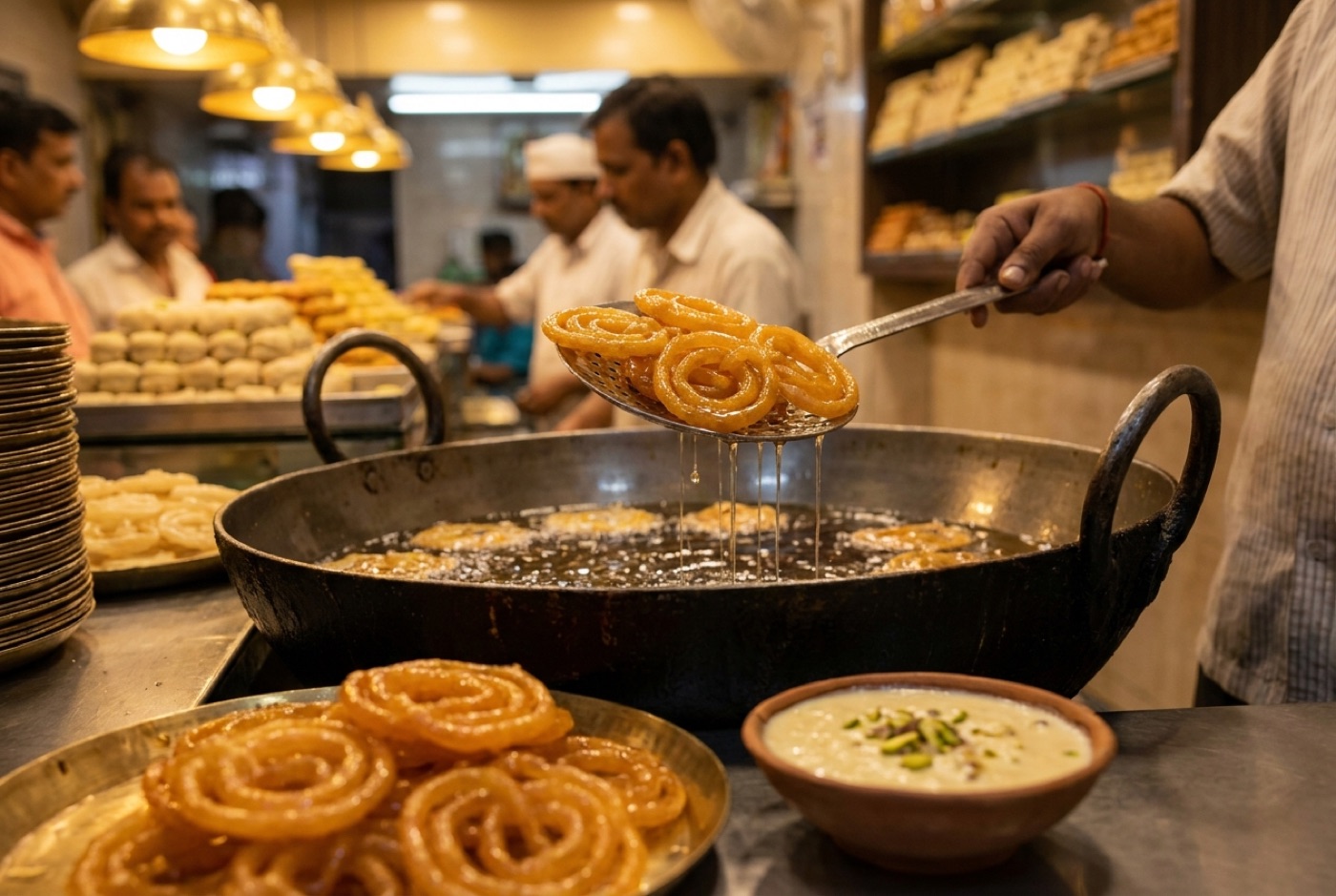
Fresh from the kadai and straight into the chashni — the two-minute window of perfection.
Khaane mein kya hai — the short answer
The batter — maida lightly fermented (traditionally overnight, often with a little dahi or besan) for tang and crunch.
The fry — piped in freehand spirals into ghee, until shatteringly crisp.
The chashni — warm saffron-cardamom sugar syrup that floods the hollow coils.
Stand at a halwai's counter early in the morning and watch the jalebi-wala work. A cloth bag or a squeeze bottle, a wrist that learned its geometry decades ago, and freehand spirals dropped into shimmering ghee — no two alike, every one perfect. Jalebi is the rare dessert with handwriting.
The secret is sour
The unglamorous truth behind that bright, joyful taste: fermentation. The maida batter rests — overnight in the classic method — until it turns faintly, deliberately sour. That tang is jalebi's backbone; against the sweetness of the syrup, it's what keeps the whole thing from being a sugar bomb and makes it interesting instead. The fermentation also aerates the batter, which is why a good jalebi is hollow, light and crisp rather than dense and doughy.
The dunk
Straight from the ghee, still blazing, the coils go into warm chashni — sugar syrup scented with saffron and cardamom, cooked to just the right stickiness. The hollow tubes drink it up. This is jalebi's two-minute window of perfection: syrup-heavy, edges still crisp, heat still rising. A jalebi eaten an hour later is a pleasant sweet. A jalebi eaten at the kadai is an event.
Some desserts are architecture. Jalebi is handwriting — no two alike, every one signed.
How to eat it like you were raised right
Hot jalebi with cold rabri — thickened sweet milk — is the classic power couple, the temperature contrast doing half the work. In parts of the north, jalebi with warm milk is breakfast, and in Indore and Bhopal they'll hand you jalebi with poha in the morning and call it civilisation, correctly. And a fresh hot jalebi on a winter morning needs no partner at all — just both your hands and no witnesses.
Quick answers
How is jalebi made?
A lightly fermented maida batter is piped in spirals into hot ghee or oil, fried until crisp, then dunked immediately in warm saffron-cardamom sugar syrup so the hollow coils absorb the chashni.
What do you eat jalebi with?
Classically with cold rabri (thickened milk) or warm milk; in Madhya Pradesh, famously with poha for breakfast. Fresh and hot from the kadai, it also needs nothing at all.
#Jalebi#Mithai#Halwai#KhaaneMeinKyaHai
Take any dish apart with enough love, and you'll find a story holding it together.