The Samosa: A Traveller Who Never Left
It crossed deserts with Persian traders, dined in Delhi's sultanate courts, and ended up at every Indian railway station. So — khaane mein kya hai?
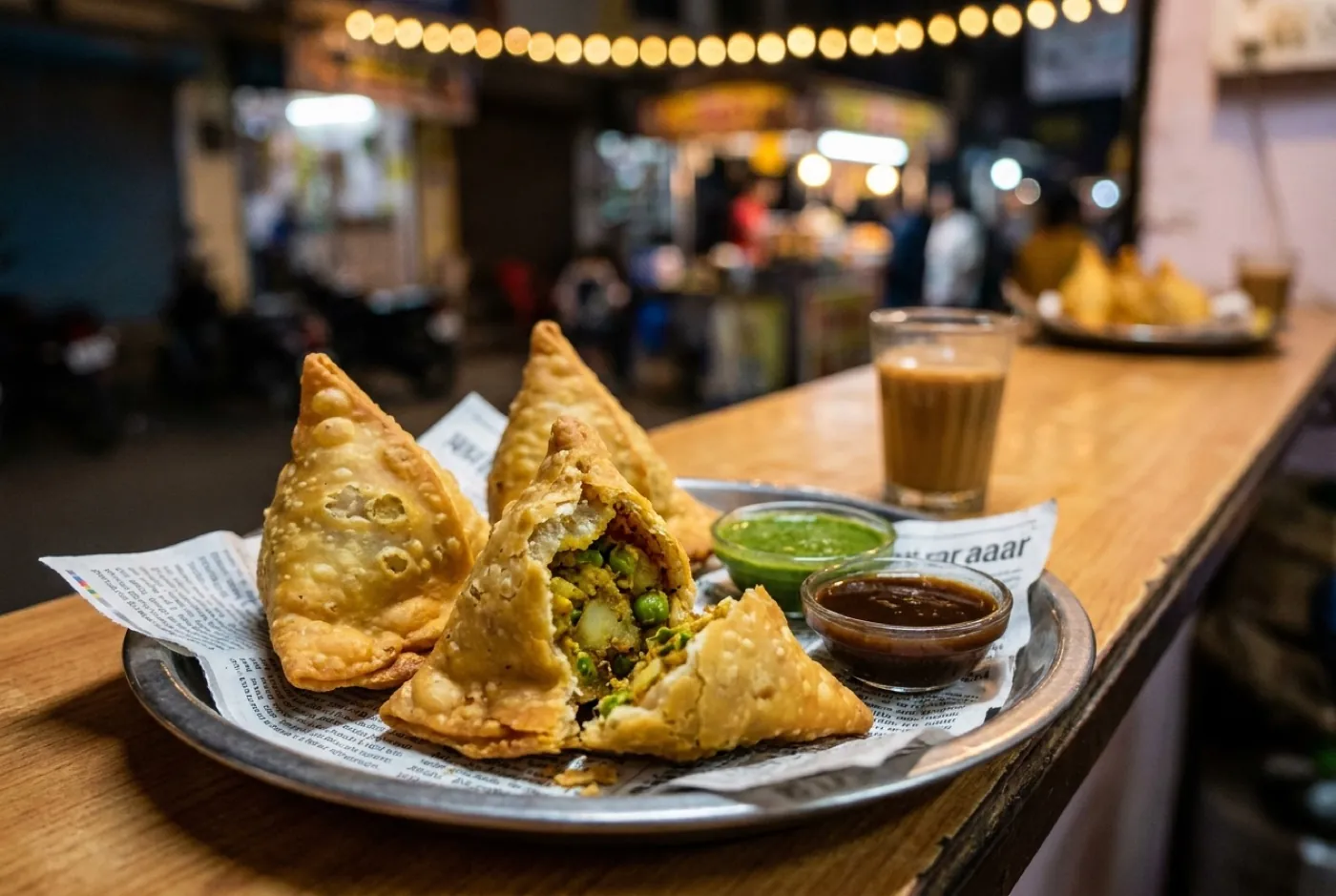
Khaane mein kya hai — the short answer
- The shell — a stiff maida dough with ghee (the "moyan") that fries into flaky armour, not bubbles.
- The heart — spiced potato and peas: cumin, coriander seed, green chilli, amchur for tang.
- The escorts — green coriander-mint chutney and sweet tamarind, plus chai as the constitutionally mandated partner.
Before it was Indian, the samosa was a traveller. Its ancestor — call it sanbosag, sambusak, samsa — rode across Persia and Central Asia in saddlebags as a portable meat pie, and arrived in the subcontinent around the thirteenth century, where court chroniclers of the Delhi Sultanate wrote admiringly of princes snacking on it. India did what India does: adopted it, argued with it, and improved it beyond recognition.
The great potato coup
The modern samosa's defining moment came centuries later, when the Portuguese brought the potato to India. Somewhere along the way, the aloo staged a coup, evicted the mince, and installed itself — mashed, studded with peas, perfumed with cumin and coriander seed, brightened with amchur — as the rightful heart of the people's samosa. The meat samosa survives, gloriously, in Hyderabad and old Muslim quarters. But the aloo samosa became the republic.
Engineering the shell
The pastry is where amateurs fall. It is a stiff dough of maida with a generous rub of ghee — the moyan — which is what gives that flaky, blistered, khasta bite. And the frying is counterintuitive: low and slow, so the shell cooks through and crisps gradually. Hot, fast oil makes bubbles and a pale, sad shell. A proper samosa should sound like dry leaves when you break it.
The samosa entered India as a royal snack and stayed as a public servant.
A democracy of triangles
Today it costs less than a bus fare and shows up everywhere: railway platforms at dawn, office chai breaks at four, weddings, funerals, election rallies. Bengal folds it smaller and calls it singara, sometimes with cauliflower. Some cities stuff it with keema, some with noodles (we forgive them). And its destiny is the chai break — hot, sweet tea against hot, salty pastry — one of the great free pleasures of the subcontinent.
Quick answers
Where did the samosa originally come from?
Its ancestor came from Persia and Central Asia as a fried meat pastry (sanbosag/sambusak), reaching India around the 13th–14th century through traders and royal kitchens. The potato filling came much later, after the Portuguese introduced potatoes to India.
Why is my samosa shell not flaky?
Two usual culprits: not enough ghee rubbed into the dough (the moyan), or frying at high heat. Use a stiff dough and fry low and slow — the shell should crisp gradually, without bubbles.