Street Food Diaries: Monsoon in Mumbai
When the first heavy rain arrives, an entire city changes what it craves — and starts eating standing up, in the downpour, shoulder to shoulder.
The short version
- The Mumbai monsoon transforms the city's cravings toward hot, fried, hand-held street food.
- Vada pav, bhajias and cutting chai are affordable, democratic and deeply communal.
- Indian street food is less about luxury than about the exactly-right thing at the exactly-right moment.
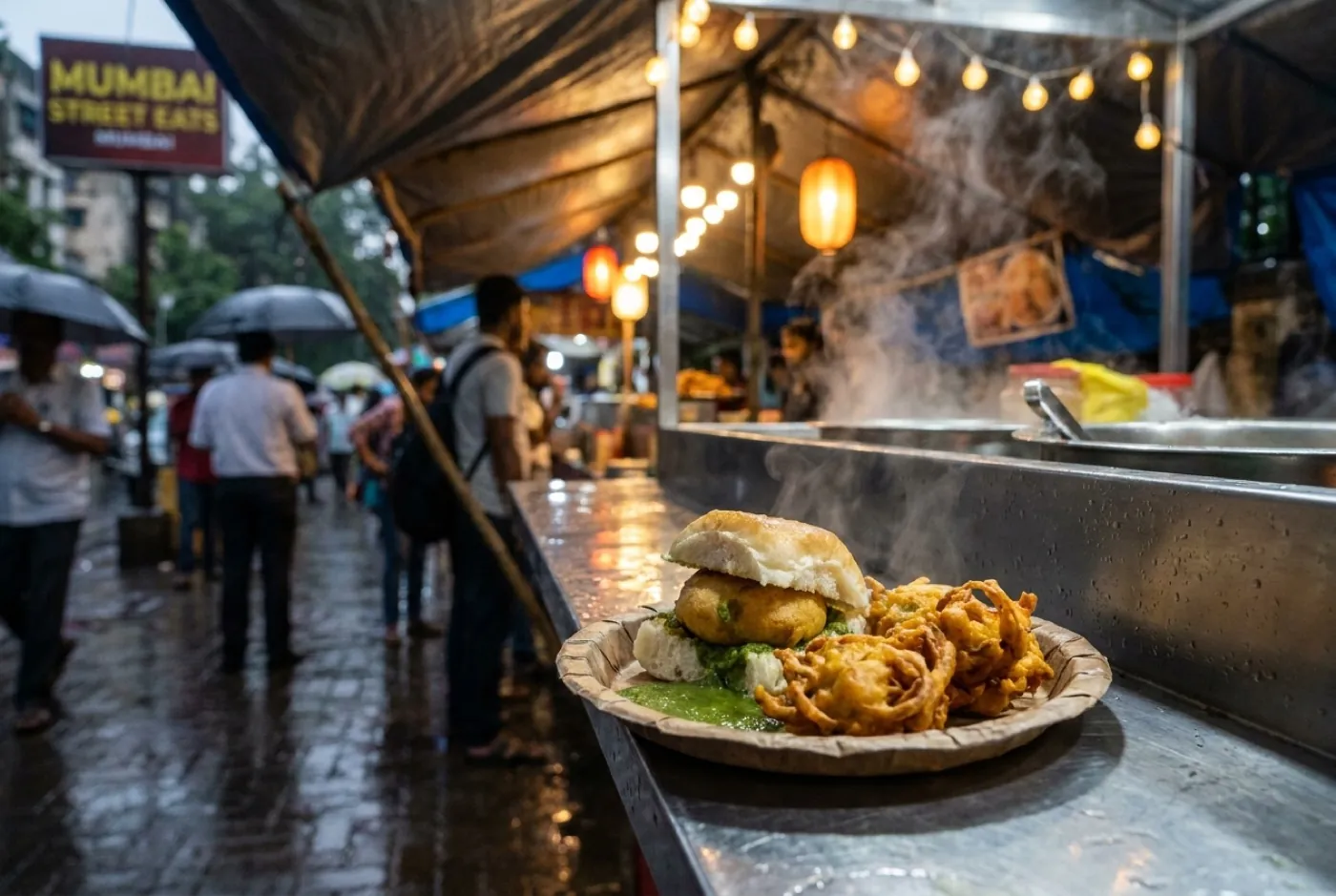
The first heavy rain of the Mumbai monsoon changes what the whole city craves. Suddenly nobody wants a salad. Everybody wants something hot, fried, and held in a paper napkin translucent with oil. The vada pav stall outside the station does its best business in the downpour — a spiced potato dumpling, deep-fried in a jacket of gram flour, crushed into a soft pav with dry garlic chutney and a fried green chilli on the side. It costs less than a bus ticket and satisfies more than a banquet.
The smell of rain on a hot tawa
Down the lane, a man ladles bhajias into hissing oil — onion, potato, sometimes a whole green chilli battered and fried until the whole street smells of festival. You eat it burning your fingers, washing it down with cutting chai poured from a great height into a glass the size of a promise. The rain drums on the tarpaulin. Strangers stand shoulder to shoulder under it, briefly a family, complaining happily about the trains.
Mumbai's street food is democracy you can eat: everyone stands, everyone waits, everyone burns their tongue the same.
The exact right thing at the exact right moment
This is the genius of Indian street food. It is not about luxury; it is about precision of craving. A bhutta — corn roasted on coals, rubbed with lemon, salt and red chilli — on a grey wet evening tastes better than anything a white tablecloth could serve. Pani puri delivers six seconds of tamarind-cool-spicy chaos and then demands you order another. Pav bhaji arrives glistening with butter on a griddle the size of a table. Each is engineered, over generations, for a specific hunger and a specific hour.
More than a snack
To eat on the street in India is to join something. The stall owner who remembers your order, the shared bench, the ritual of the second plate you swore you wouldn't have — this is community, priced for everyone. The monsoon doesn't ruin the city. It seasons it, and sends everyone out into the rain looking for the same warm, crunchy comfort at the same glowing stall.
Common questions
What is the most famous Mumbai street food?
Vada pav — a spiced, deep-fried potato dumpling in a soft bread bun with chutneys — is Mumbai's signature street snack, often called the "Indian burger." Pav bhaji, bhel puri and pani puri are close companions.
Why is street food so popular during the monsoon?
Cool, rainy weather makes people crave hot, fried, savoury food. Fresh bhajias (fritters), corn on the cob and hot cutting chai are the classic monsoon cravings across Indian cities.
What is "cutting chai"?
Cutting chai is a small, strong half-glass of milky spiced tea — a "cut" portion — served cheaply at stalls so you can have a quick, hot drink and a chat without committing to a full cup.